Francis Burger: I'll try to keep things short and sharpish. I wanted to go back to the thing of intermission, like literally just what it is for you, all the different things, but also in particular, you mentioned the actual intermission between films.
Alastair Mclachlan: So the format of most, if not all drive-ins, is a double feature. They have the first movie, then the intermission, and the second movie. Sometimes for longer movies they have a reel change in between, but essentially the intermission is for the projectionist to change the reels. I think for the most part, most films, as far as I know, come on three reels. They're able to sync them, there's normally a little highlight in the top corner, when the reel changes…
The first drive-in I ever went to was the Swartkops drive-in, which is actually still there. They've turned the tarmac into a go-kart rink, and they've built the perimeter of the thing with these discarded wheels – the wheels came without the cars to the drive-in.
F: Or the wheels came off.
A: There's a whole lot of nostalgia for a lot of people about drive-ins, and it's not even particular, it's like, the things that everyone did are the lore of drive-ins.
Like, it was important that you had to try and cheat the system and not pay tickets. So you used to climb and hide in the back seat, put a blanket on or hide in the boot or something like that, just so you didn't have to pay the extra admission. For the most part, kids went in their pajamas. Growing up in the eighties, you'd have a bath and then you would eat supper, and then, sometimes, you'd go to the drive-in, and each little car would be this little private capsule. But during intermission that sort of spills out.
My brother and I were usually tasked with going to the cafeteria in our pajamas to go get popcorn and sweets and drinks. Half of the fun about going to the cafeteria was actually going past and seeing the cars as you walked past – getting a glimpse into those private spaces. Intermission had its own sort of, sort of mythology…
Put it this way – I don't think drive-ins made the best choices when it came to the content they were showing, there's a long history of that, they started out with slasher films, soft porn, and stuff like that. There was a conservative backlash, and in the end they were almost forced to do PC versions. So they kind of shot themselves in the foot, especially a place like the Top Star Drive-in. Top Star should have been showing Godzilla movies and things, they were just missed opportunities, you know, with the city and the backdrops.
Actually with Top Star the residential area started to encroach on the lot, people used to be able to watch the drive-in from their houses…
F: I kind of remember that! Like parking next to the fence and trying to tune in, I wonder if that was actually a thing that I did or just something that friends told me about… I'm pretty sure I went to the drive-in, it would've been like just a couple times, it wasn't like a culture, you know? But we went, there was one in Durban, I know sort of where it was…
It's so true what you say about this specific nostalgia, it's such a weird feeling that it comes with, so cinematic… Maybe because my mind has sort of mutated into the half asleep late night kid state where you're like, dreaming about the film. It's quite intense to try and recollect it…
A: It is, it's got its own sense of being immersive, it's not immersive like a cinema is but it has context. It's like everything at play around the screen, including the car and your neighbors and the shooting stars in the background, sort of factor into it.
The Durban Drive-in used to be over the road from the ice rink.
F: Yes!
A: So that's another, you know, these kinds of things, the nostalgia for these kinds of things, it goes with ice cream trucks and the ice rink – there's something about community there, old school physical contact. Drive-ins also had Sunday car boot sales…
F: Yes! In the day. I remember that quite clearly, the boot sales…
There was something I wanted to go back to there, you mentioned the phrase 'I remember', a book that you wanted to make, or is that the title of the drive-in project?
A: For my drive-in project the title is 'drive-in-ry' with both English and Afrikaans coupled…
I'm also just recalling watching a movie at the Durban Drive-in, in the rain, everyone was there with their wipers on…
F: That's crazy, talking about 'pull to erase…'
A: Sorry, I distracted myself.
F: It's okay it just reminded me of the magic screen, and to have a page that's just like, windscreen wipers for your computer screen or phone… Did you ever have the little sheep on your desktop? We used to have these little sheep that would like eat grass and then like pee and whatever, and like fall off things and stuff. I'm just imagining a download where you could have a car dash pov on your computer, and then every now and again, it starts raining and you turn the wipers on… I think it's coming back though, this era… I really think we are going back into this time of like, having more fun on, on the internet.
A: Can I ask you a question? The drive-in stuff is so rich, with all these projects – I work on them and I put them aside, it's always like an ongoing thing – but out of everything we spoke of the other day what made you choose this topic?
F: Intermission?
A: Oh, I suppose it's the intermission. Intermission.
F: I also wanted to come back to this, the '[ ]' symbol – because you told me about intermission, aspirationally, as these square brackets, then you spoke about the drive-in.
A: Mhmm-Hmm, makes sense.
F: You were saying that initially it was just that, the symbol, and then it sort of became intermission…So at first it started, it was just the square brackets…
A: It's actually never been that. It's always been 'intermission', but this '[ ]' or [ … ] has always been the intention. And yes, conceptually, it was always that intermission is an in-between space.
F: That kind of draws the drive-in intermission, the literal intermission, into proximity, and then this '[ ]' configuration as an inbetween – so like both-and…
A: I think the first show I saw at the drive-in was Who Framed Robert Roger Rabbit, that was a good one, but mostly, with double-features, one of the films was shit. You might go, and really just want to watch one of the films, but you would generally stay and watch the shit one anyway.
Intermission had a life to it that that was different, and it was much better than, especially from a kid's perspective, sitting in the backseat looking at your parents' heads – unless you turned the car backwards and put a mattress down, there were all sorts of ways to get around that…
Intermission was the event, it always held this heightened excitement, a little bit of magic, an electricity.
F: It's almost like '] ['
A: Or it's kind of like a little bit like '] [ ] ['
F: You know what I mean!? Because it's between, whatever happens in that space has the grace of not being hyped – it's not known, it's not scripted. You're let loose of your parents, the containment, or as you said, privacy, of that capsule… there's the risk of bumping into someone, strangers…
So how does that then become intermission for you – as an artist who does events, who does… I don't know, what is your Instagram bio thing, "see make do", as an artist who "sees, makes and does"?
A: That's a good question. I also should just illustrate what you've just illustrated.
F: Yes, exactly.
A: So… (drawing a diagram of three screens) this is the feature film and for the duration of that, there's something projected on the screen… Over here and over here, they're both blank. This is sort of like a white screen during the day. This is sort of like a black screen at night, you can't see it. This is obviously the intermission…
And, man! Intermission adverts were a whole thing in themselves, like very sort of, hotdog wieners jumping into buns…
F: Like psychedelic almost? I'm thinking of like fantasia level… sorry Dumbo, not fantasia, Dumbo's dream, he gets a little drunk and has this dream of elephants flying around…
A: I think it all concretised when I did the bus tours. I just called them Intermission Bus Tours because the main event of the tour was to do something at Top Star during intermission. So it was Felix in Exile being shown at Intermission at Top Star, but I also collected content from South African video artists that I was showing from, from the bus.
The idea was that their films were not fully fledged, they were low budget, rather than feature films – it was the antithesis of Hollywood. It's linked to the question of how, when you meet someone, you say, 'what's your pet project?', or 'what's your passion project?', 'What's the one that's underneath your bed?' I knew I had them, and I wasn't so interested in what someone was showing at their gallery, or things like that.
I still ask people that, because the content that we found was… it wasn't stuff that people were ready to show, or anything like that. I was just saying 'bring it to me'. There were these tiny little shorts – you could kind of put it together with an indie film festival, it's the independent ethos, the experimentation – the way that everything, and anything, can happen.
At about the same time, intermission was always my drive-in project. It wasn't 'the intermission project', it was the drive-in project, but as soon as it went on the road, it literally took up space in between the two features.
I mean, Wolfe's Electric Kool-Aid Acid Test, they had one of those old buses where you could change the destination on a banner, and someone wrote 'further'. So that's something that's physical, it has a tangent, it doesn't make 'sense', but it's so full of possibilities.
F: And it is that, right? This image for me, of the brackets meeting each other from behind, is also something like Xeno's paradox, halfway to halfway to halfway to halfway. There's a kind of multiplication, it's indivisible, or maybe, there's a nice new word that I've been enjoying recently: indeterminate. Not infinite, just indeterminate. I love it. It's so different to 'infinite'.
A: There's a nice hop skip and jump from that idea, to the intermission, to what we were doing with The Venue. This is the venue's floor plan, you can see the square brackets. This was the space to occupy, to do those kind things in… We had a very sort of Robinhood business model. We'd get paid ridiculous amounts of money from corporate shoots and events, and on the back of that we could do an exhibition or a poetry event, film screenings, things like that.
F: And this was at the Lister building?
A: Yes this was, is, an abandoned laboratory at the top of the Lister Medical Building…
We had a Ster Kinekor event at the Venue. I remember chatting to someone, like the head of Ster Kinekor, and I was like, 'what's going on with your drive-ins?', and he just said, flat to my face, drive-ins are dead.
You could see the back of the Top Star drive-in from the venue, when it came to the demolition I could tell that something significant had happened, and I could rush down and take some photographs. I remember I went to a public meeting, a community meeting, to raise concerns, and I asked a question, said something about drive-ins… The whole room went quiet like, oh shit, this guy's gonna cause shit, and I said look, it's a done deal, I'm just here to find out. Turned out that the Top Star drive-in – someone owed someone rent or something like that – but it's last I checked, they dismantled it and put it in storage somewhere, the entire fucking screen.
It was such an interesting idea that you could take this whole drive-in and then pack it up – like a jack in the box or, you know, put it in the box and open the box… it's a pop up, drive-in…
F: It also kind of makes me think of that image, the photographs that composite incrementally, and that repetition…
A: So, back to this space, the '[ ]', essentially it is a blank space, the blank screen, the tabula rasa. It's the idea that a blank piece of paper represents infinite possibilities…
F: Further…
A: I had some ideas of taking paint ball guns to the old drive-ins, shooting paint at the screen, or of getting a harness rig and then with a paintbrush and just like swinging, creating this massive arch. But as nice as those ideas were, I couldn't improve on the blank screen…
Especially when, very often, the drive-in screen would lose one panel or something, and it's like this grinning thing, and they're just losing – there's a word for it, when someone loses a tooth or the gap between teeth, it's actually the title for one of my works. But that's how they slowly sort of started decaying, losing a tooth, that and the paint flaking.
I came across an old floppy disc the other day, and I'd just written with chalk on it, 'the slow decay of minimalism', where you've got this very clean thing that's brand new and just… There's a scientific formula for entropy, something like that, how everything tends towards that… Or something Neil Young said, 'rust never sleeps'. So there's something alive in the decay. I remember also that I never documented drive-ins that were alive. I was drawn to them in retrospect because of my memory and the sort of nostalgia, the magic that still lived there, but I only documented them in their state of decay. There's this leftover, or intrinsic energy that sort of crackles like an old radio, these ghosts of the past. There's a great Afrikaans saying for it, 'katte sien spoke' [literally, cats see ghosts].
F: What kind of spoke?
A: Katte sien spoke…
So the old drive-ins were just magnetic for me there. I'm drawn to derelict spaces and junk yards and things anyway, but there was something particular about those drive-in spaces.
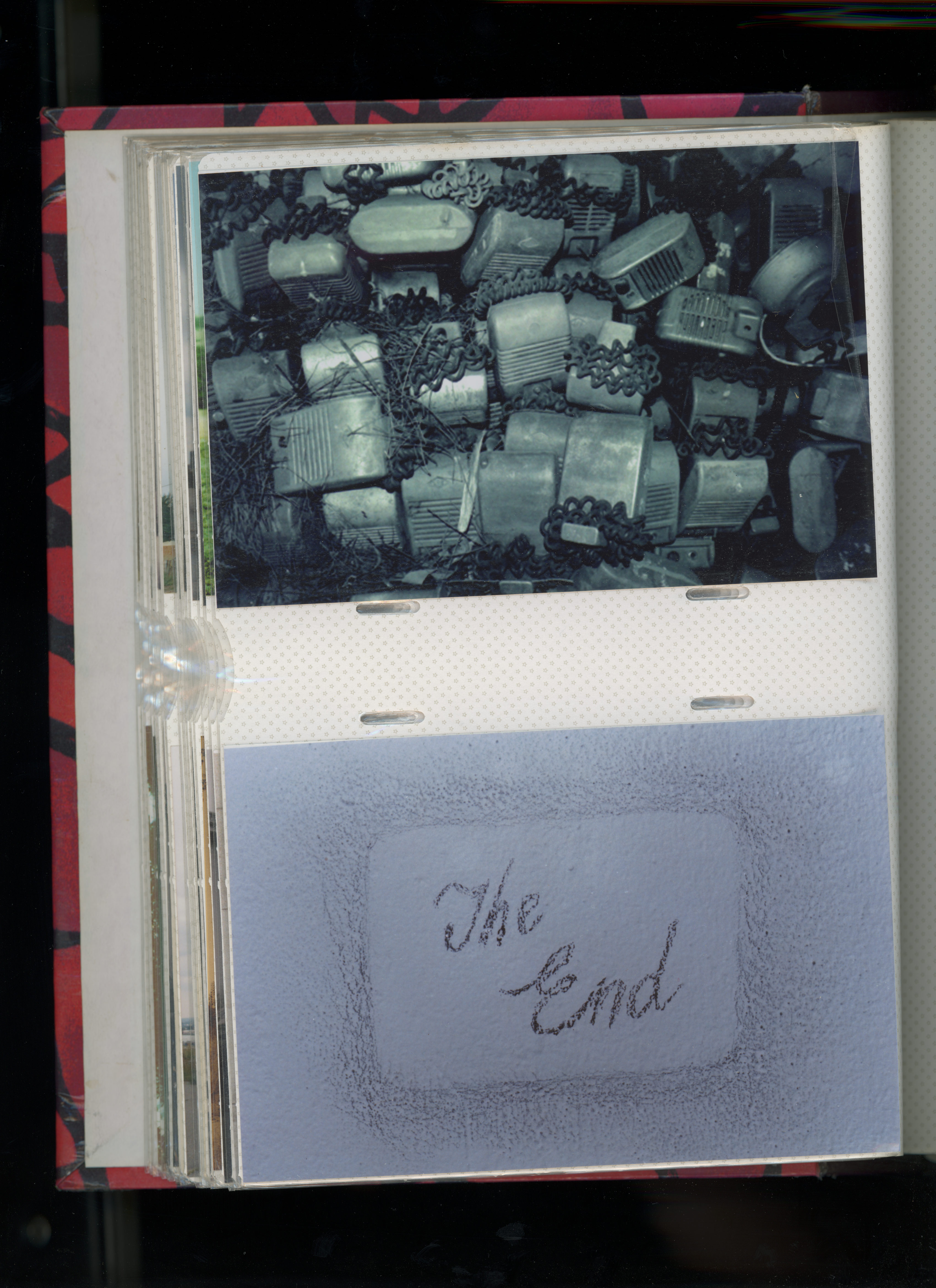
Some of them still had the metal poles with the speakers. I went to the Bethlehem Drive-in, and it was just a piece of veld – the screen was gone, but there were these metal poles… The police force had taken over the property and were stationed at the old cafeteria…
I managed to get into the projection booth, which was like a bunker, a security bunker… Somehow all the speakers ended up inside the projection booth.
So you had this vault, that was black, no lights, but then opening up the shutters, it was almost like little sleepy eyes opening, and inside was a pile, big pile, of drive-in speakers. So I pulled up my Ford Capri, popped the boot, and just started, like, piling it full of speakers.
Two cops came around with their alsatians, and I've got my hands full of drive-in speakers, and asked me what I was doing. But as they came into that scene, it was as if they forgot that they were asking me the question, they got so distracted, and walked right past me.
F: They got nostalgia'fied…
A: They were so transfixed.

A: So I've told you that I've done murals or paintings of things, of a drive-in, and then projected 16mm films onto them. It's quite illusionistic – my paintings have never been particularly big, maybe four meters at the most – so you have to suspend your disbelief, but it does work… At some point you kind of get sucked into that feeling, you're not at a drive-in, but you're at a fantasy version of it. I'd love to be able to expand that, painting and then position speakers all around. The drive-in speakers are usually rated zero to five in sound quality, but it's the ones that sort of crackle and pop that are kind of cute and interesting.
F: Okay, so I want to write this up for intermission, for the index, because I think that this could basically be an opening entry, right? This is a lovely little piece of text that we've just made right now, together with maybe some of these little doodles and things and whatever. But I mean, you have so much content, so it would maybe also just be about like, adding a few extra things, that projected eye with everybody standing in the foreground silhouetted against that. That's the pink bus right?
A: Yes, the pink bus was the bus that went to the intermissions. But, I wanted to also go back to 'I remember'... It fascinated me that whenever I had a drive-in exhibition, the first words out of people's mouths when they spoke to me was, 'I remember'. They didn't want to talk about the show, they wanted to tell me their drive-in story, and it would always start with 'I remember…'.
F: I mean it literally happened earlier. I was like, oh, I remember parking next to, by the fence of the drive-in…trying to tune in. Then I remembered you saying that from our earlier conversation, and I was like, damn, I just did the thing. I remembered.
A: So in the background, there was the idea of a standalone drive-in site where people could share their stories, a kind of cultural history of drive-ins, so people could riff off each other.
F: I mean, it can be like a little letter box, you know, it can just have a little comment form, whatever, and it's just attached to an assigned email address – it's like a little suggestion or request box or whatever, 'speak to the projectionist'.
A: Something else on that, well, a couple of segues… Johnny, Johnny Galvin, he was a projectionist, I actually have his writings on drive-ins, and I interviewed him.
I remember I responded to an ad in Durban for some guy that was selling 16mm films, it turned out to be the Durban drive-in's projectionist. I went to go visit him and he had film stacked in the kitchen cupboards, underneath his bed, in his cupboards, and he was very reluctantly getting rid of stuff. I also used to go to newspaper archives and go into the microfiche film things, just trying to get as much drive-in stuff as I could…
F: That will make a great sub-cat, I think, that whole archive, we can just incrementally upload things. The other thing that I was thinking could be nice to just have online sooner rather than later are the fire books, they're just something that was very striking for me.
A: Can I tell you about the connection there? I've always loved fire, but my brother was the pyromaniac… He burnt a hole in the carpet in our room once, and so we moved our beds around and then used to play marbles with this perfect little hole in the room…
For me, it was in about third year in art school, or in second year, we had a little face to face with our lecturers – and it's, it's a valid criticism and you will see it in my collections – they were like, this is such a great idea, then you turn the page and you're going in such a different direction, why not just stick to one thing, you're so spread out… We want to see you build on something, take a direction and mine it.
I had just gone to Newcastle and there was a veld fire I took some photographs of, and then there was the drive-in that happened to be called Die Vlam in-ry (drive in), that was burnt down for insurance purposes, the guy was bust… So I said, okay, I can't pick one, but I'll pick two – I chose to focus on fire, and drive-ins.
F: You said that there were other elements as well, water, air… So the set came later, from fire?
A: That kind of came later because I felt like I wanted to explore the others, to flesh the fire out.
F: Nice, that makes sense, it's almost like subsidiary… I felt almost disappointed when you said there were other elements. So this kind of chronological explanation makes sense to me, water etcetera as a subset of fire.
A: So astrologically, and sort personally, I'm very water oriented. So the fire is working with the opposite. I also was born in Hammanskraal next to a dam, and the reason my folks moved was because I constantly tried to drown myself. Every time they stopped looking at me, I was on the way down to the dam.
F: You wanted to, you're saying you wanted to drown yourself, or you wanted to swim, you wanted to…
A: I was drawn to the water.
F: So, the only other thing was to just check on the Last Thursday program, I don't know what you guys are planning…
A: There isn't really a program except that this might be the first of a series… I was going to try and have the first one last month, but it was like, ridiculousness, like just chill.
Tamzyn (from downstairs): It is a series of things!
F: I was going to say also, about the party on Saturday night.
T: There's the exhibition in your house, of your whole life... There are photos on the tv, there's balloons
A: Okay, okay, Francis already told me I was schizophrenic the other day…
F: Did I say that?!
A: Not really, I was talking about a group exhibition and you said 'you are the group'.
F: Oh, yes, yes totally, you're the group. Don't put words in my mouth, Alastair… I'm recording!
Photographs above by Alastair Mclahlan.
To be contacted via the intermission mailing list send an email to: addme@intermission.co.za